
Insights
Insights
In the latest UK government survey, 43% of businesses reported a cyber breach or attack in the previous 12 months. That is why frameworks and certifications matter. They give organisations a structured way to manage cyber risk instead of relying on ad hoc decisions.
The problem is that these terms are often used interchangeably when they should not be. Some are frameworks, some are certifications, some are useful starting points and others are only worth pursuing when there is a clear regulatory or commercial case.
If you are trying to decide among Cyber Essentials, Cyber Essentials Plus, ISO 27001, Cyber Assessment Framework, and The NIST Cybersecurity Framework (CSF) 2.0, the first step is to understand what each is for.
A framework helps you to organise your security programme. It gives you a structure for thinking about risk, controls, priorities and improvement.
Whereas a certification confirms that your organisation has been independently assessed against a defined standard at a particular point in time.
That distinction matters, a framework shapes how you run security, and a certification proves something to clients, regulators, insurers or procurement teams. A mistake many organisations make is chasing certification to improve their security without adopting an underlying framework. While the certification may be passed, the organisation will not improve their security posture by as much as by adopting a framework alongside the certification.
Cyber Essentials is the UK government’s recommended minimum standard for cybersecurity. It is built around five technical control areas designed to protect against common internet-based threats.
For most organisations, it is the right place to start. It is affordable, achievable and widely recognised. It also has clear commercial value. Government guidance says the scheme helps protect against almost all cyber threats, and organisations with the controls in place make 92% fewer insurance claims.
It also matters in procurement. Since 2014, the UK government has required suppliers bidding for certain public contracts to hold Cyber Essentials or CE+, or show equivalent controls are in place.
If your organisation has never formally assessed its cyber baseline, this is usually the fastest, highest-value first step.
Cyber Essentials Plus covers the same five control areas as Cyber Essentials, but with independent technical verification rather than self-assessment. The controls are tested directly through environmental assessment and sampling.
That difference is commercially important. Cyber Essentials states that you have declared the controls are in place. CE+ says an assessor has tested them.
If you supply larger clients, work in regulated sectors, or need stronger assurance for procurement and cyber insurance conversations, CE+ is often the more credible option.
Where Cyber Essentials focuses on a defined technical baseline, ISO 27001 (or to give its full title: ISO/IEC 27001:2022 – Information security management systems) is about how the organisation manages information security as a system. ISO describes it as the world’s best-known standard for information security management systems, with requirements for establishing, implementing, maintaining and continually improving the system.
This is a bigger undertaking than Cyber Essentials. It is not just about technical controls. It covers governance, risk management, scope, policy, roles and continual improvement.
That makes it valuable for organisations handling sensitive information, operating internationally, or working in enterprise and regulated supply chains. It can be a strong commercial differentiator, but only when the investment is proportionate to the value it brings.
Not every business needs ISO 27001 now. The right question is whether it supports your current client requirements, regulatory context and growth plans.
The Cyber Assessment Framework, or CAF, is not a certification. It is a framework developed by the National Cyber Security Centre to help organisations assess and improve cyber security and resilience where essential services are at stake. The NCSC says it is primarily designed for sectors such as energy, healthcare, transport, digital infrastructure and government, and supports legal and regulatory requirements such as the NIS Regulations.
CAF is structured around four objectives: managing security risk, protecting against cyber-attack, detecting cybersecurity events, and minimising the impact of incidents.
If your organisation operates essential services, supports critical public functions, or supplies heavily regulated sectors, CAF is likely to matter. If not, it is still useful as a maturity framework, but it is not usually the first thing a typical SME should pursue.
The NIST Cybersecurity Framework (CSF) 2.0 is one of the most widely used cyber risk frameworks in the world. NIST published version 2.0 on 26 February 2024 and added a sixth core function, Govern, to the existing five: Identify, Protect, Detect, Respond and Recover.
That matters because it makes governance and leadership more explicit. The Cyber Assessment Framework (CAF) is a tool to help organisations assess and improve their cyber security and resilience, managing cyber risks and protecting essential services from cyber threats.
NIST is not a UK certification requirement like Cyber Essentials, but it is an excellent way to structure a security programme. If you want a broad risk-management framework that aligns well with other standards, NIST is one of the best options available.
This is where organisations often get it wrong.
Certification shows that you met a standard at the time of assessment. It does not guarantee that your security posture remains strong afterwards.
That is not a flaw in the certification model. It is simply how point-in-time assurance works.
The better way to think about it is this: the framework is the discipline; the certification is the proof point. If you treat certification as the destination, you risk building a compliance exercise instead of a security programme.
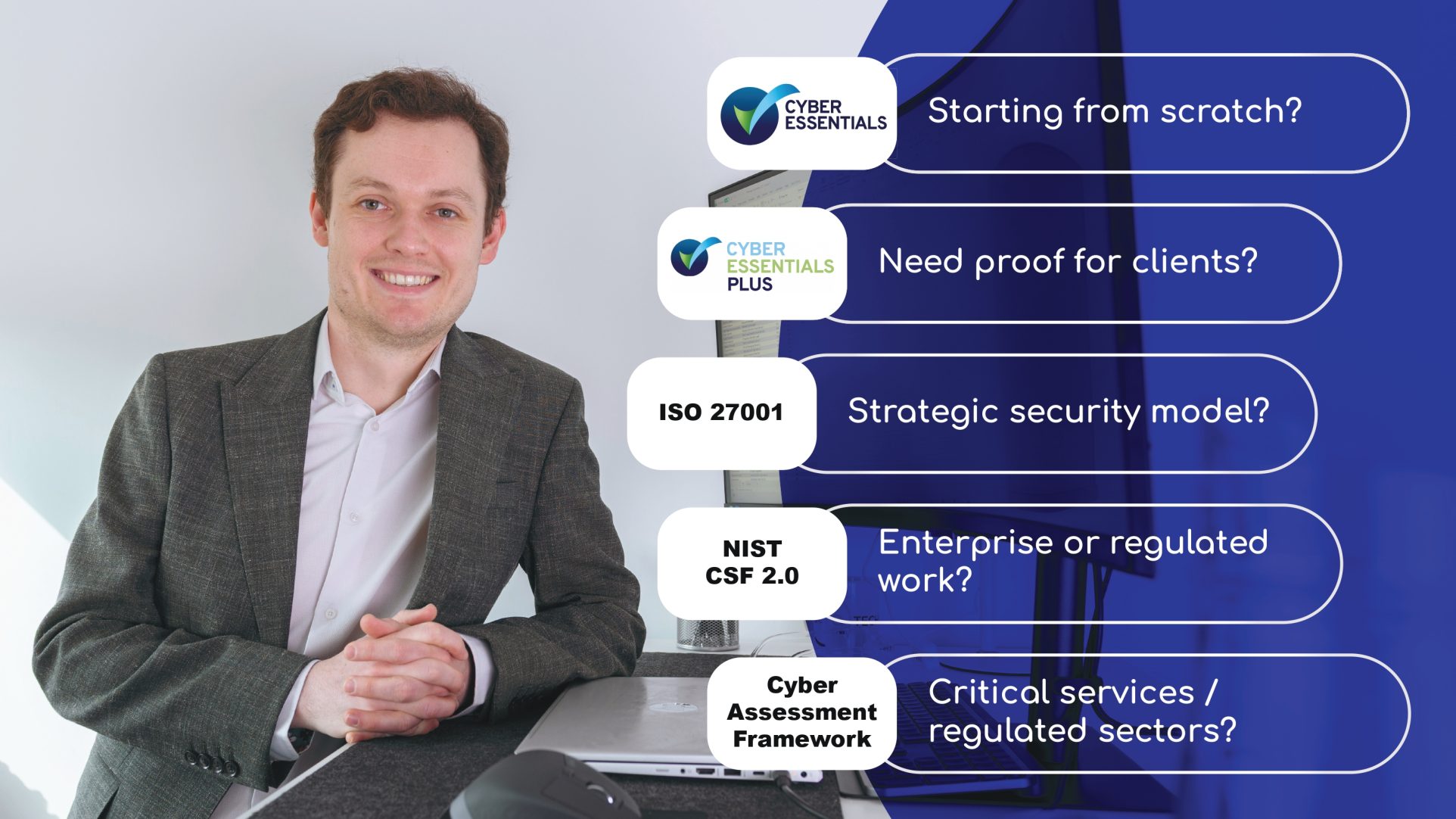
If you are starting from scratch, the simplest route is usually the right one.
Start with Cyber Essentials. It provides a recognised baseline, supports common procurement requirements, and addresses the most common categories of preventable attacks.
Move to CE+ if you need stronger assurance for clients, insurers or regulated work.
Consider ISO 27001 when there is a clear business case, usually driven by enterprise clients, regulated markets or the need for a formal management system.
Use The NIST Cybersecurity Framework (CSF) 2.0 to structure your overall security thinking, and use Cyber Assessment Framework where your sector, regulator or clients expect it.
Before you commit to any path, ask three practical questions.
What do your clients or procurement processes require?
For some organisations, this decides the answer immediately. Cyber Essentials and CE+ are already embedded in parts of UK public procurement.
What does your regulatory environment expect?
If you operate essential services or supply regulated environments, CAF may matter more than a generic certification pathway.
Where are you now?
If you have never formally assessed your current posture, choosing a certification first can be the wrong move. A structured assessment will show you what is already in place, where the material gaps are, and which route makes sense.
Frameworks and certifications help you understand what good looks like. They do not tell you whether your organisation is secure today.
If you want to know where you stand before committing time and budget to Cyber Essentials, CE+, ISO 27001 or a broader framework programme, start with evidence.
A Cyber Security Assessment gives you a clear view of your current security posture, highlights the gaps that matter most, and shows which actions should be prioritised first. Instead of guessing which certification or framework is right for you, you get a practical understanding of your risks, your maturity, and the most sensible next step for your organisation.
A Penetration Test takes that a step further by showing how your controls perform under realistic attack conditions. It helps identify weaknesses that can be exploited in practice, so you can fix them before they become incidents, audit findings or procurement blockers.
Together, these services give you something more useful than a badge on its own: a clear picture of where you are exposed, what to fix first, and how to move forward with confidence.
If you are deciding which standard to pursue, or whether your current controls are really doing the job, Aura Technology can help you assess your position, test your defences, and build a roadmap that fits your risk and commercial reality.